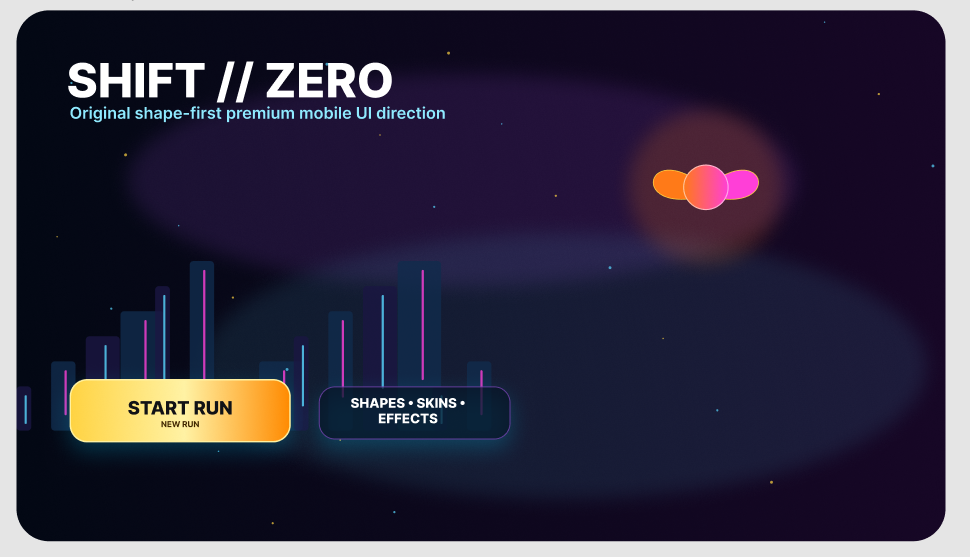
Short Overview
SHIFT ZERO is a mobile-first Godot 4 game project built around one-touch gravity shifting and rule-changing modifiers. The M0 architecture foundation is complete; the core gameplay prototype is the next milestone.
Problem
In fast-paced, visually chaotic action games, critical player information (health, ammo, objectives) is often lost in the noise. The challenge was to design a UI that matched the aggressive, neon-drenched cyberpunk aesthetic while maintaining absolute clarity and split-second readability.
// HUD.CLUTTER
Information loss in high-intensity gameplay
Technical Implementation
The Godot foundation uses five dependency-checked layers: Presentation, Gameplay, Systems, Services, and Core. External integrations sit behind interfaces, gameplay configuration is data-driven, and CI checks linting, forbidden dependencies, and architecture boundaries.
My Approach
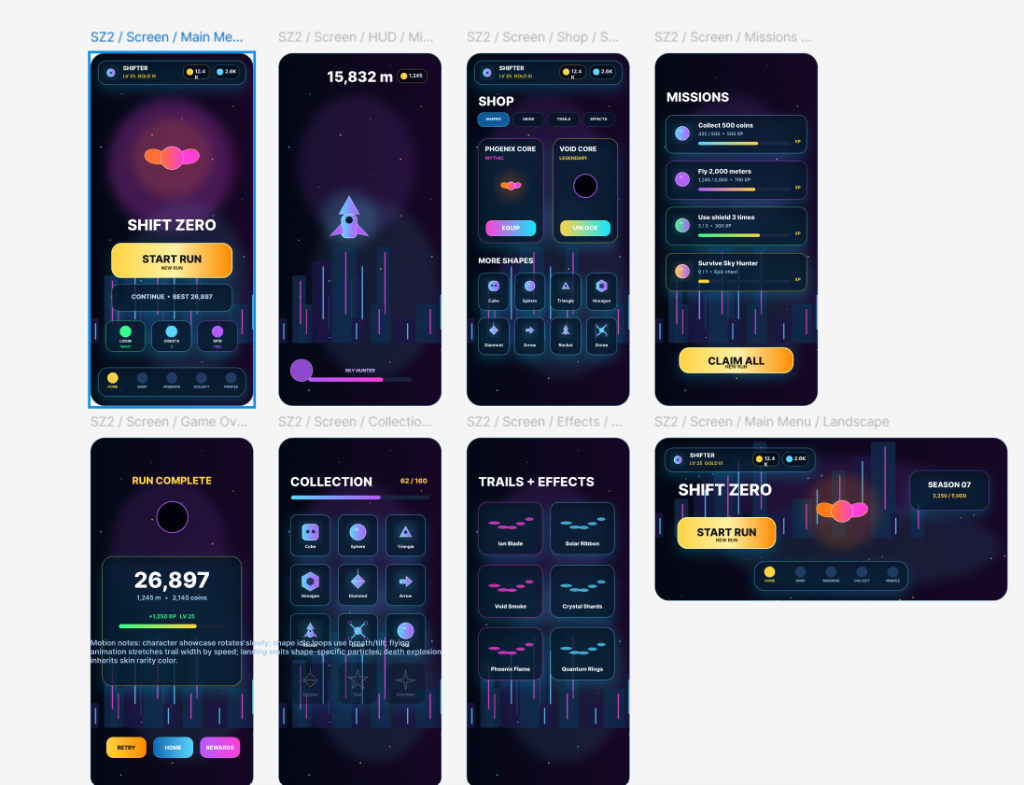
I separated visual direction from game architecture. The HUD work studies aviation interfaces and high-contrast state changes, while the Godot project establishes services, configuration, logging, event flow, test structure, and decision records before gameplay complexity is added.
Design Decisions
- Typography: A highly legible, aggressive sans-serif direction conveys technical precision.
- Color: Saturated accents are reserved for critical state changes against a restrained monochrome base.
- Diegetic elements: Angled projections and scanline details connect the interface to the game world without obscuring core information.
Challenges
The central challenge is designing a modifier-driven game that can evolve without coupling gameplay to analytics, billing, remote configuration, saves, haptics, or presentation. The UI challenge is preserving rapid readability inside a visually aggressive direction.
Result
M0 delivers the documented, testable production foundation: strict dependency layers, service interfaces, seeded randomness, configuration, feature flags, input recording, CI scripts, and a complete roadmap. Gameplay remains in development and is not represented as shipped.
Key Features
- High-contrast, readability-focused HUD direction
- Five-layer Godot architecture with CI boundary checks
- Data-driven configuration and replaceable service interfaces
- Offline-first, accessibility, and ethical monetization requirements documented up front
Lessons Learned
The work reinforced the value of defining architecture boundaries and accessibility constraints before a game loop grows. The next milestone is validating those decisions in a playable core-loop prototype.